Lumiruby
Pulse Forge
Pulse Forge
Couldn't load pickup availability
Self-paced learning overview
- 📦 Digital file available after purchase
- 🔄 Long-term availability
- 🛡️ Secure checkout
- 🔄 Content updated in 2026
Pulse Forge is a course that helps you move from understanding Ruby basics to comfortably working with its powerful mechanisms. ⚙️
After Free Pathway, you already know why everything in Ruby is an object and how symbols work. Now it's time to apply that knowledge in practice: write cleaner, more flexible, and more efficient code using collections, blocks, and iterators.
What’s included
6 modules with videos, a large number of code examples, in-code comments, independent exercises, and logic-checking tasks.
Module 1: Deep work with arrays and hashes
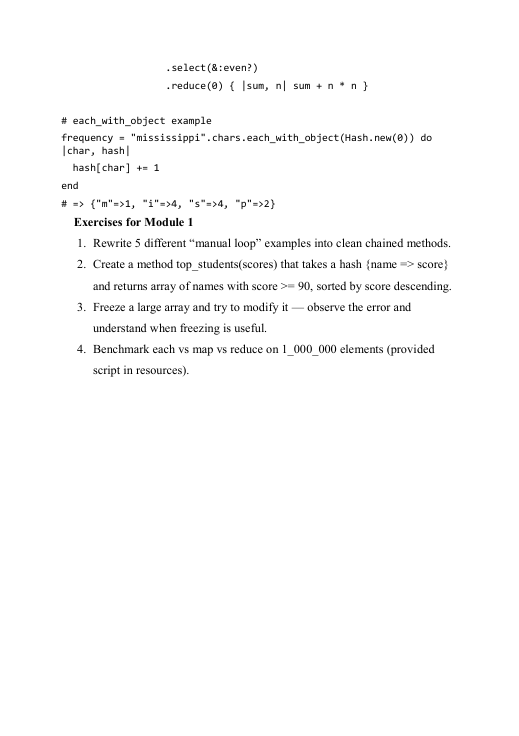
map, select, reject, reduce, inject methods • method chaining • frozen arrays and hashes ❄️
Module 2: Blocks as Ruby's core tool
yield vs explicit block • block_given? • &block as argument • real Enumerable examples
Module 3: Iterators and Enumerable
each vs each_with_index vs each_slice • custom iterators via Enumerable • lazy enumeration with Enumerator
Module 4: Proc and Lambda — first steps
Proc.new vs lambda • differences in return behavior • usage in sort_by, group_by
Module 5: Range and other Enumerable classes
(1..100).step, (a..z), Date ranges • usage in loops and iterations
Module 6: Practical exercises on code cleanliness
Refactoring typical "spaghetti" examples • using blocks for DSL-like syntax
Who this course is for
Suitable if you:
- completed Free Pathway or have equivalent knowledge
- want to stop writing "long" code and start using blocks and iterators naturally
- are ready to complete exercises that require understanding logic, not just copying 😌
Not suitable if you:
- are not yet familiar with Ruby's object nature
- are looking for a quick overview without practical tasks
What you will study
How to chain collection methods for compact code
How to create and pass blocks for flexibility
The difference between Proc and Lambda in real examples
How to write custom iterators and use lazy approaches
How to avoid common block and return mistakes
About the author
Developer with over 8 years of Ruby experience. Worked with large data collections, automation, and scripts where iteration and block efficiency was key. 📚
30-day refund policy
If within 30 days after purchase of paid tariff you feel the materials do not suit you — write us for refund (for Free Pathway not applicable).
Share